Wednesday, October 12, 2011

Spartacurtus and the Nymphs of the Island of Lesbos

Salve! 
Consul Spartacurtus sum!  

In our Classics Club meetings, we've discussed performing a play. It just so happens that I wrote a play for my Latin class as part of an extra-credit project, so I'd like to contribute my Latin writing to the cause. I have included the original play about me, Spartacurtus, and how I ended up with the Nymphs of the Island of Lesbos. I understand that this play is terribly self-aggrandizing, but I never really wrote this play with the intention that anyone except me and my Latin teacher, Magistra Lemmon would ever read this, and I certainly never expected it to be performed. I haven't gotten to make the corrections as notated by my former magistra, (alas, even Spartacurtus' Latin isn't quite perfect.) but I have included the original transcript with all its errors and corrections. 
I hope you enjoy. Unfortunately, the English translation has been lost. If any of you Latin scholars wish to translate this, please feel free to do so, and PLEASE post the translation in the comments section! 
~Spartacurtus Rex Ancillarum~ 


Friday, September 9, 2011

"Tu es lonesome nocte, Brutus?"

Are you Roman tonight? Statue of 'Elvis' chiselled 1800 years before his birth goes under the hammer

By NIALL FIRTH

Last updated at 1:18 PM on 22nd July 2008


With his dashing chiselled features, swept back hair and perky bouffant the resemblance is unmistakable.

But incredibly this carving of Elvis Presley was created around 1800 years before the King of Rock and Roll first warbled his first note.

The amazing likeness has come to light as part of a sale of ancient antiques by the auction house Bonhams.

elvis

Classic Elvis: The statue bears an unmistakeable resemblance to the real King

The Roman Elvis is in fact a genuine marble acroterion - a kind of architectural ornament often found for decoration on the corners of a sarcophagus, a stone tomb or burial chamber.

 Elvis

The real thing: Elvis in concert in 1968

It forms part of a collection owned by Melbourne-based Graham Geddes - one of the world's most foremost collectors - which is estimated to sell for more than £1m when it goes on sale in October.

Even the Geddes himself has nicknamed the astounding lookalike ‘Elvis’.

Antiquities specialist Georgiana Aitken added: 'It bears an uncanny likeness to Elvis Presley. It's the quiff that does it.

You do some weird and wacky things at the corners of sarcophagi.

'I don't know what purpose they served and the quiff was not a hairstyle of the day as far as I know.'

The 'Elvis’ sculpture is 2nd Century AD and is estimated to make £25,000 to £30,000.

A spokesman for Bonhams said: "It is perhaps the strangest item in the sale, certainly to modern eyes.

"Fans of the King of Rock 'n Roll, seeing this face from the distant past will be forgiven for thinking that their idol may well have lived a previous life in Rome!

"Looking at this face with its Elvis-like quiff, strong jaw and nose, one is inevitably led to the thought that the human face for all is diversity and subtlety has after all an ability to repeat itself."


Read more: http://www.dailymail.co.uk/news/article-1037205/Are-Roman-tonight-Statue-Elvis-chiselled-1800-years-birth-goes-hammer.html#ixzz1XTCwCi2L

Wednesday, August 31, 2011

Archaeologists uncover amphitheatre used to train gladiators near Vienna

Archaeologists uncover amphitheatre used to train gladiators near Vienna

The ruins are a 'sensational discovery' with a structure to rival the Colosseum in Rome, archaeologists say

The Colosseum in Rome
The Colosseum in Rome – the largest amphitheatre built in the Roman empire. Photograph: Francesco Survara/Alamy

Archaeologists say they have located and excavated the ruins of a huge amphitheatre used to train gladiators east of Vienna, describing it as a "sensational discovery".

They claim that the ruins found through ground radar measurements rival the Colosseum and the Ludus Magnus in Rome in their structure. The Ludus Magnus is the largest of the gladiatorial arenas in the Italian capital, while the Colosseum is the largest amphitheatre ever built in the Roman empire.

A statement on Tuesday from the Carnuntum archaeological park gave no details about when the find was located and excavated.

Monday, August 22, 2011

Perseus with the Head of Ronald McDonald


Italian artist Giuseppe Veneziano updated the Greek myth of Perseus and Medusa with this sculpture. It’s a bit harsh. I mean, Ronald McDonald never turned anyone into stone.

Artist’s Website (some NSFW images) -via Kurositas | Photo by Flickr user mamasaurus rex used under Creative Commons license

UPDATE: In the comments, Sylvian proposes that this sculpture is actually a take on Caravaggio’s David with the Head of Goliath. I think he’s right.

Thursday, August 11, 2011

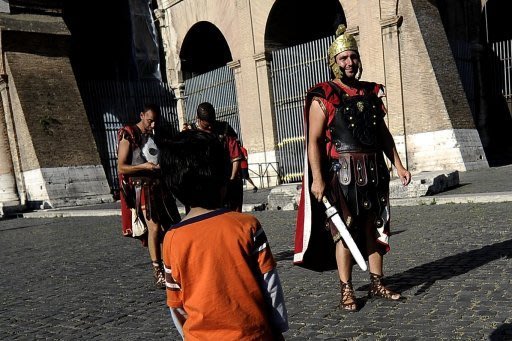
Rome police arrest Colosseum 'gladiator' gang

A child looks at men dressed up as gladiators in front of Rome's Colosseum in JuneAFP 
Italian police have arrested 20 gladiator impersonators in an undercover sting aimed at ending a violent racket operating around Rome's most famous tourist sites, Italian press reported on Thursday.
Police disguised as gladiators, dustbin men and members of the public raided the gang made up of seven families working with five tourist agencies.
The modern gladiators are accused of attacking and intimidating competitors for a lucrative business in which gladiators collect up to 10 euros ($14) for having their picture taken alongside tourists in front of attractions.
The police officers disguised as gladiators were beaten up by the alleged criminal gladiators before other undercover officers swooped in.
"Gladiators" are a feature of the Roman landscape for tourists, with men decked out in bright red capes, helmets with plumes of red feathers and sandals while carrying swords and round shields.
They can be found outside the Colosseum, Castel Sant'Angelo, Piazza Venezia and even in front of St Peter's Basilica in the Vatican, preying on the millions of tourists who pass through Rome every year.
Criminal gangs had divided up these tourist sights and were defending their territory with violence, the police said.
Five competitors who had been chased away alerted police to the gang's activities, leading to the sting operation.